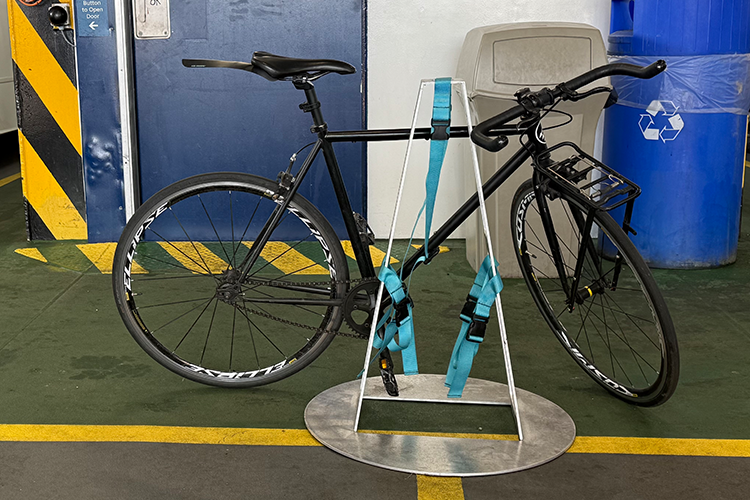
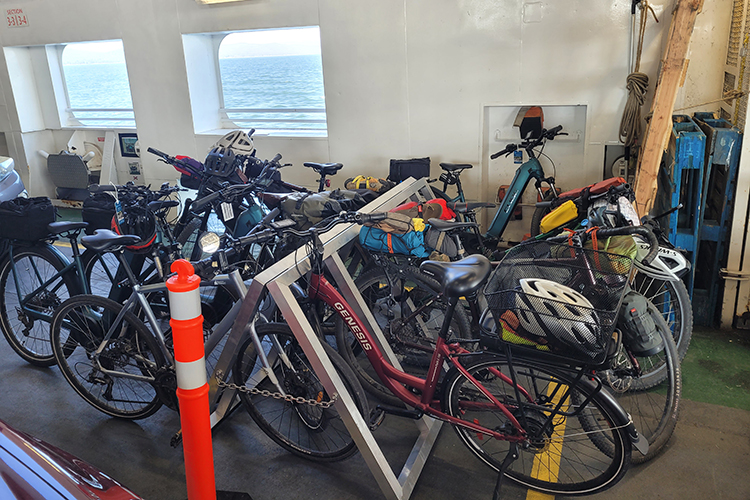
What is a Proof of Concept (PoC) bike rack?
A Proof-of-Concept bike rack is a deliberately small-scale trial of a new onboard bike storage solution. The trial is being tested on select sailings on one vessel this September 2026.
Why is BC Ferries testing bike racks?
We’re testing two proof-of-concept bike rack solutions on the Salish Eagle to address a customer and employee pain point: Salish-class vessels do not currently have dedicated bike racks, which can lead to bikes being stowed inconsistently and, at times, blocking access to safety equipment. The trial is designed to improve onboard bike storage so the experience is safer, clear and more consistent for both cyclists and crew.
Why is this trial taking place now?
Cycling demand increases significantly during the summer, and the route between Tsawwassen and the Southern Gulf Islands has one of the highest cyclist volumes in our system. Today, Salish-class vessels do not have dedicated bike racks, which can make bike stowage inconsistent and can create safety concerns when bikes block access to safety equipment. BC Ferries is testing a potential solution on one vessel to better understand whether it improves safety, usability and the customer and crew experience.
Why is the trial taking place on the Salish Eagle?
This route, where the Salish Eagle operates between Tsawwassen and the Southern Gulf Islands, is a multi-stop route with high seasonal cycling demand, making it a strong real-world test environment. A recent task analysis confirmed the route’s operational complexity and the need for clear, more consistent bike stowage.
Will this impact vehicle space on the vessel?
The trial bike rack designs are intended to fit within existing deck space, with the goal of improving organization and safety without reducing vehicle capacity.
Will this trial change how cyclists board or disembark, or slow downloading or unloading?
Crew will continue to determine the safest loading approach for cyclists using the bike racks. Cyclists may be loaded either before or after vehicle traffic, depending on operational requirements and as directed by a crew member. The focus is on improving how bikes are stored onboard while maintaining safe and efficient vessel operations, and BC Ferries will monitor any impacts on loading, unloading and overall vessel operations as part of the evaluation.
How will BC Ferries determine if the trial is successful?
BC Ferries will assess the trial based on customer and crew feedback and operational performance, including safety, usability, whether bikes remain organized and clear of safety equipment, and how well the solution works in real sailing conditions.
Who is responsible if a bike is damaged while using the trial racks?
As with current practice, customers are responsible for their personal belongings. BC Ferries is not responsible for damage to any vehicle or its contents, including bikes. The trial has been designed with safety as a priority, and BC Ferries will monitor performance closely to confirm the racks support safe bike storage.